India’s Nordic Diplomacy Is More Than Symbolism — It Could Rewire Trade, Tech, and Investor Opportunities

India’s Nordic Push Has a Bigger Strategic Meaning
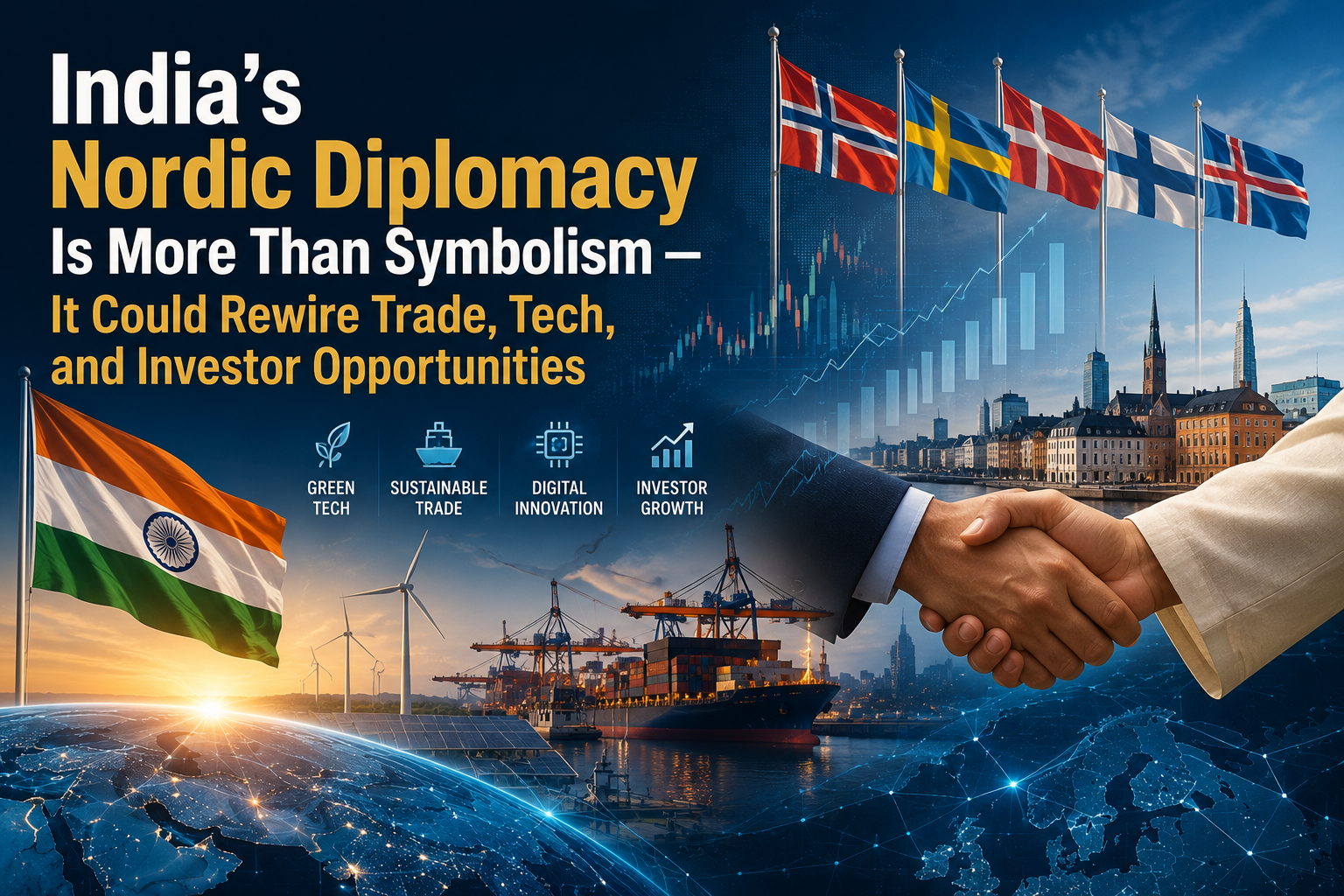
Prime Minister Narendra Modi’s Nordic visit has done more than strengthen diplomatic ties. It has placed India at the centre of a growing coalition of advanced economies that are deeply invested in green technology, resilient supply chains, digital infrastructure, and sustainable industrial growth. The 3rd India-Nordic Summit in Oslo signaled that this relationship is no longer ceremonial; it is becoming a practical platform for trade, investment, and geopolitical alignment.
For India, the timing is important. Global trade is becoming more fragmented, energy security is under pressure, and countries are searching for reliable partners outside traditional blocs. The Nordic nations, known for high technology standards, climate leadership, and strong institutional credibility, fit neatly into India’s long-term economic strategy. The result is a partnership that has implications not only for foreign policy, but also for sectors listed on Indian stock exchanges.
What the Summit Actually Delivered
The summit elevated the India-Nordic relationship to a Green Technology and Innovation Strategic Partnership. That phrase may sound diplomatic, but it carries real economic weight. The focus areas included green hydrogen, low-carbon shipping, circular economy models, digital infrastructure, artificial intelligence, climate finance, healthcare, space, and defence cooperation.
One of the most important takeaways for investors is the reinforcement of India’s trade architecture. The summit welcomed the India-EFTA Trade and Economic Partnership Agreement, which can support new investment flows, improve market access, and deepen industrial ties with Switzerland, Norway, Iceland, and Liechtenstein. The leaders also backed wider connectivity, including the India-Middle East-Europe Economic Corridor, which strengthens India’s role in global trade logistics.
This is not just about trade agreements. It is about building a more resilient India-centric supply chain ecosystem that can attract capital, technology, and export demand over the next decade.
Why It Matters for Global Geopolitics
The Nordic partnership matters because it gives India more strategic flexibility in a turbulent world. Europe is looking for dependable partners to reduce excessive dependence on a narrow set of supply chains, while India wants access to advanced technology without becoming over-reliant on any single geopolitical camp.
The Nordic countries bring credibility in climate policy, maritime governance, digital trust, and sustainable manufacturing. India brings scale, a young workforce, policy momentum, and a fast-growing domestic market. Together, the two sides can influence how green industrial standards, digital rules, and clean energy cooperation evolve across Europe and the Indo-Pacific.
In geopolitical terms, this is a quiet but important signal: India is not just responding to global uncertainty. It is actively shaping a new trade and technology order.
What It Means for Indian Stock Market
For the stock market, the direct effect is not immediate fireworks. Instead, this is a medium-term theme that can gradually improve the earnings visibility of several sectors.
The biggest beneficiaries are likely to be:
- Renewable energy and grid infrastructure companies.
- Capital goods and engineering firms linked to green technology.
- Logistics, ports, and shipping names.
- Export-oriented sectors such as textiles, leather, marine products, and gems and jewellery.
- Defence and advanced manufacturing companies.
- IT and digital infrastructure providers tied to AI, 6G, and trusted cloud systems.
The logic is simple. When trade agreements reduce friction, exports become more competitive. When policy cooperation supports clean-tech investment, capital goods and industrial suppliers benefit. When sovereign partnerships deepen, capital flows and industrial confidence improve.
There is also a second-order market effect. As India aligns more closely with high-income, high-standards economies, companies that can meet global compliance, sustainability, and quality benchmarks are likely to enjoy premium valuations over time.
What Investors Should Watch
Investors should avoid treating this as a short-term trade and instead view it as a multi-year structural opportunity. The key is to track companies with real operating leverage to policy and export expansion.
Look for businesses that have:
- Exposure to renewable energy equipment and project execution.
- Capabilities in hydrogen, storage, smart grids, or clean industrial systems.
- Strong export books in textiles, marine goods, or jewellery.
- Partnerships or order flows linked to Europe and the Nordics.
- Balance-sheet strength to benefit from long-cycle industrial capex.
The best opportunities may come from companies that are not yet obvious “story stocks” but can convert policy support into revenue growth and margin expansion. In a market where narratives often move faster than fundamentals, this visit offers a narrative backed by strategic intent.
Table 1: Likely Beneficiary Sectors
|
Sector |
Why It Benefits |
Investor Relevance |
|
Renewable energy |
Green technology is a core focus of the partnership |
High |
|
Capital goods |
Demand rises for industrial and clean-tech equipment |
High |
|
Logistics and ports |
Trade corridors and supply-chain resilience gain importance |
Medium-High |
|
Textiles and leather |
Better export access under trade liberalisation |
Medium-High |
|
Gems and jewellery |
Export competitiveness improves with reduced trade friction |
Medium |
|
Defence |
Cooperation can support advanced manufacturing and technology transfer |
Medium |
Table 2: Investment Themes from the Visit
|
Theme |
Policy Driver |
Market Impact |
|
Green hydrogen |
Strategic partnership with Nordic climate leaders |
Long-term industrial growth |
|
Digital infrastructure |
AI, 6G, and trusted systems |
Higher technology valuations |
|
Trade diversification |
EFTA and EU engagement |
Export-led earnings improvement |
|
Maritime and blue economy |
Low-carbon shipping and connectivity |
Logistics and shipping tailwind |
Final Takeaway
India’s Nordic visit should be read as a high-quality strategic signal. It strengthens India’s standing in a world where technology, climate, and trade are increasingly linked. For investors, the message is equally clear: the winners are likely to be companies that sit at the intersection of clean energy, export manufacturing, logistics, and digital infrastructure.
This is not a story of one-day market excitement. It is a story of where India’s next wave of industrial and geopolitical advantage could come from


Leave a Comment